

Paper
Hungary under Viktor Orbán deployed right-wing populism as a foreign policy strategy, embedding the country in a web of illiberal transnational networks whose legacy will endure even after his April 2026 electoral defeat.
Zsuzsanna Végh
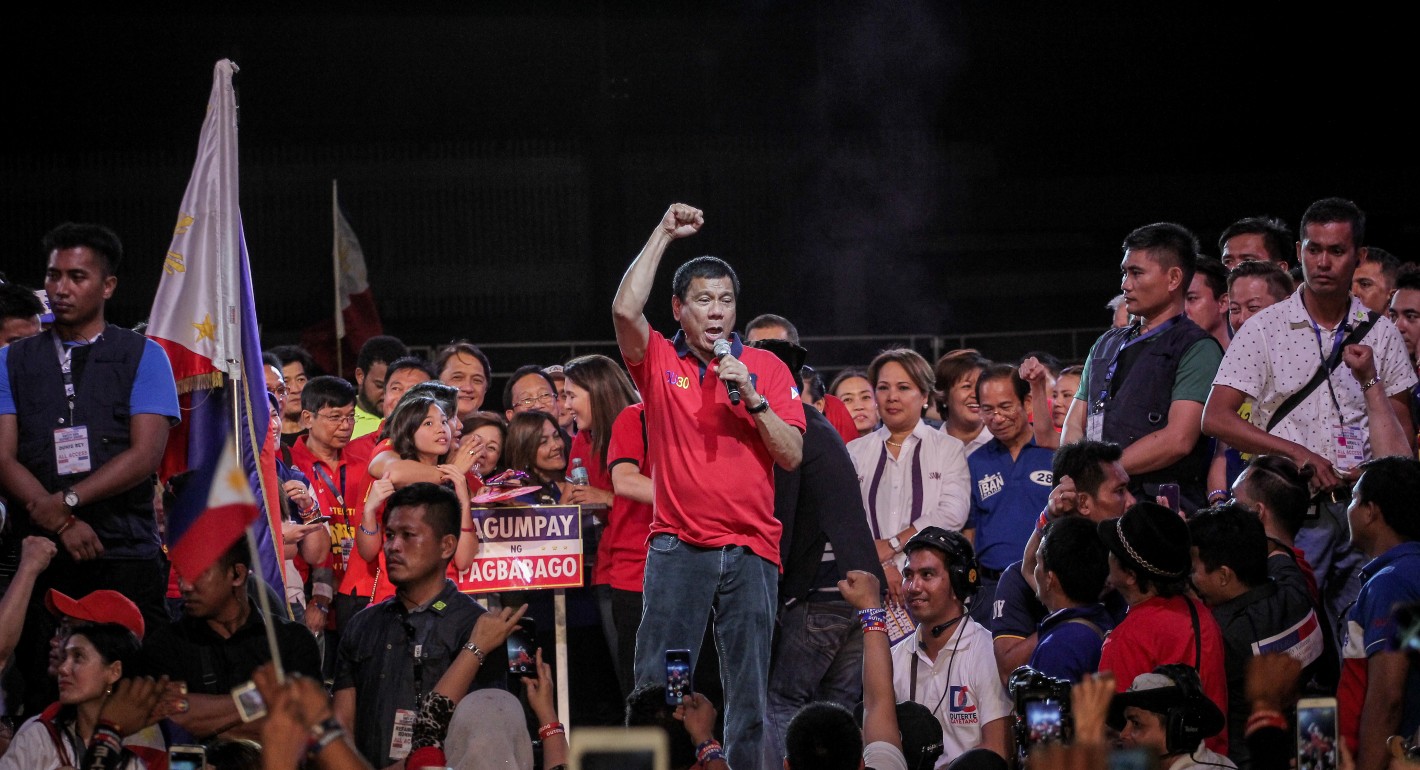
Credit: Basilio Sepe. Used with permission.
In the Philippines, Duterte-era discourse emphasizing sovereignty, anti-Western skepticism, and strongman diplomacy mirrors tenets of populist foreign policy around the world.
This paper is part of “The Populist Turn in Middle-Power Diplomacy,” a Carnegie Endowment series on the international impacts of right-wing populism. Focusing on middle powers, the series explores how populist leaders reshape foreign policy, build transnational networks, and advance shared agendas across borders.
Barely two months into his presidency of the Philippines, Rodrigo Duterte attended the 2016 Association of Southeast Asian Nations (ASEAN) summit in Vientiane, Laos. The former mayor of Davao City had just swept the presidential election to become the first executive from outside of the Manila-based political establishment. Rather than reading a scripted speech, he launched into an impromptu tirade about colonial atrocities by the United States. Duterte went on to defend his violent war on drugs and rebut the criticisms of his equally violent purge of suspected criminals.1 The world was shocked by the bad manners exhibited by Duterte, especially his insult to then U.S. president Barack Obama.2 This was the beginning of the shift in Philippine foreign policy toward a more populist, illiberal, and revisionist posture—one that would last until Duterte’s presidency ended in 2022.
This essay advances two core arguments about how Duterte’s right-wing populism shaped Philippine foreign policy. First, Duterte’s foreign policy was not motivated by an ideology, so much as by a performance anchored in symbolic defiance, personalized diplomacy, and selective norm rejection.3 Second, Duterte’s populist revisionism ultimately collided with entrenched structural constraints, including the country’s enduring security dependence on the United States, institutional resistance within the bureaucracy, and the democratic political succession that brought the nonpopulist President Ferdinand Marcos Jr. to power. Taken together, these constraints exposed the limits of populist foreign policy in a small and militarily vulnerable state situated on the front lines of the U.S.-China rivalry.
Since Duterte was elected, there has been widespread recognition that populism’s impact goes beyond national borders. In Europe, for instance, populists tended not to touch traditional foreign policy and security issues until the 2015 refugee crisis. The wave of populism that followed was marked by a contempt for the cosmopolitan European outlook that had long underpinned support for the European Union, liberal migration policies, and Europe’s reliance on the United States for its security.4 Populists on both the left and right are often skeptical of multilateral institutions because they restrain state power. Venezuela’s former president Hugo Chávez, for example, attempted to form alternative regional institutions in the Americas to counter U.S. hegemony.5
The revisionist impulse inherent in populism inclines its leaders toward foreign policy adventurism, even though abrupt shifts are uncommon given the durability of national strategic interests. Populist leaders also often exhibit a high risk tolerance—especially personalist leaders in command of highly concentrated state power.6 Moreover, they often see foreign policy as a means of weakening their political opponents and consolidating power at home. They also crave international recognition, which they pursue through “megaphone diplomacy” that foregrounds their personality and charisma.7 The burden of managing foreign relations is bearable for the populist up to the point that strategic reality intervenes, imposing itself in ways that leave scant room for performance. Populist politics, therefore, are unable to resist the water’s edge.
Populist leaders also often exhibit a high risk tolerance—especially personalist leaders in command of highly concentrated state power.
This essay proceeds by tracing the right-wing populist currents in Philippine foreign policy under Duterte through three major international issues: disputes with China in the South China Sea, the attempted abrogation of the Visiting Forces Agreement with the United States, and the country’s withdrawal from the International Criminal Court (ICC). Respectively, each of these issues foregrounds one of the foundations of Philippine foreign policy that Duterte attempted to undermine: international law, the Philippines’ alliance with the United States, and human rights. The essay goes on to analyze how these foreign policy stances resonated with the revisionist orientations of countries that Duterte sought inspiration from—namely China and Russia. These revisionist narratives were reinforced in the Philippines through domestic disinformation networks that learned strategies from Russia and China.8 Finally, the essay highlights the implications of Duterte’s populist policies under the Marcos Jr. administration and examines the prospects of their revival in the future.
Duterte’s brand of populism was not entirely new to Philippine politics. Pro-poor and redistributive populist leaders had emerged before and polarized the country. One prominent example was the celebrity-turned-president Joseph Estrada, who was impeached and ousted through the extra-constitutional Second People Power Revolution (EDSA II) revolt in 2001.9
What distinguished Duterte as a populist was the breadth of his support—his constituency defied the traditional boundaries of political ideology, socioeconomic class, and geographical origin. He was able to successfully garner the electoral support of those who saw themselves as victims of poverty, inequality, and injustice under the country’s liberal-democratic order. The core of Duterte’s support came from conflict-ridden, underdeveloped, and politically marginalized parts of Mindanao, the country’s second-largest island. He also drew support from the urban precariat in Metro Manila and from poor rural populations in peripheral regions of the archipelagic Philippines. His base later expanded with the incorporation of other groups such as wealthier voters who prioritize law and order, as well as overseas Filipinos who long for the progress and stability of the Philippines. Duterte has a charismatic personality that induces “the people” to willingly set aside their positions on issues and replace them with his own.10
Labeled as “Dutertismo,” this kind of populist politics displayed an emphasis on the logic of “discipline and punishment” during his presidency. Almost obsessively, Duterte made his war on illegal drugs the singular policy issue of his government. Like many other right-wing populists, he practiced “penal populism”—a style of politics that promises swift, harsh punishment of alleged criminals, especially those involved in the drug trade, in the name of protecting the “ordinary people” while sidestepping due process and human rights considerations. It frames crime as a crisis and uses tough-on-crime rhetoric and policy (including support for extrajudicial killings) to show that the leader alone can deliver order.11
Many observers did not expect that Duterte would send a shockwave through the country’s foreign policy, but serendipitous events like the intergovernmental Permanent Court of Arbitration (PCA) ruling in the Philippines’ favor against China over territorial disputes in the South China Sea helped to bring foreign policy matters to the fore. In addition, the Philippines was the chair of ASEAN during its fiftieth anniversary in 2017. These events provided unique opportunities for Duterte to project his extreme and unorthodox viewpoints into international issues. However, he also created his own opportunities to articulate Philippine foreign policy in international forums and on state visits.
Duterte’s war on drugs came to define his approach to foreign policy, pushing the Philippines away from its previous emphasis on the rule of law, multilateralism, and respect for human rights. The populist firebrand divided the world into countries that supported his anti-drug campaign and those that did not. He reiterated his unconditional stance in October 2016 during his first trip to China:
You know, when I said, “I will kill you if you destroy my country,” [I meant] I will kill you if you destroy the youth of the land. By any stretch of imagination that cannot be an actionable wrong. It is an expression of self-preservation. I have every right to protect the Filipino as I am the President.12
A month into the Duterte administration, the PCA delivered final judgments in favor of the Philippines in its long-standing dispute with China over boundaries in the South China Sea.13 Winning the case had been a priority of the previous administration, but instead of immediately laying the groundwork for its enforcement, Duterte shelved the ruling, instead prioritizing smoothing bilateral relations with China and seeking its pledges of economic and security cooperation.14
Duterte visited Beijing in 2016 and described his meeting with Chinese President Xi Jinping as “springtime” after years of mutual discontent.15 Both leaders pledged to continue stalled cooperative ventures and embark on new ones ranging from intelligence sharing and the combating of illegal drugs to public infrastructure, agriculture, and people-to-people exchange. This partnership reportedly entailed $24 billion worth of deals, loans, and aid.16 In the process, Duterte praised China’s generosity, identified with its ideology, and promised to pursue a new alliance. In the same vein, he announced an economic and military “separation” from the United States. After the trip, it was reported that China’s coast guard granted Filipino fishermen access to the disputed Scarborough Shoal.
Despite Duterte’s simple and direct positions on the most divisive issues, the underlying logic of these positions was neither simple nor direct. His desire to improve the Philippines’ tumultuous relations with China was motivated by foreign policy realism defined by his acceptance of the evident power asymmetry between the two countries and China’s regional hegemony in Asia. Given that the Philippines is one of the oldest U.S. allies in the region, China possessed a strong interest in deepening relations with the Philippines. Indeed, Duterte’s anti-U.S. rhetoric communicated that his country could distance itself from its traditional ally and pursue a closer relationship with China.17
Duterte’s opening to China, however, damaged his country’s relations with the United States. Duterte might have opted for a hedging strategy that situated Manila between Washington and Beijing, but he instead took an adversarial posture toward the former. Duterte’s stance was driven by his beliefs about America’s colonial sins, a bad experience with the U.S. government when he was Davao City mayor,18 and the United States’ criticism of his war on drugs. Like other populists, he emphasized Philippine sovereignty, insisting that the United States had grown too comfortable with undue intrusions into the internal affairs of the Philippines. In his off-the-cuff statements, he threatened to abrogate a long-standing military alliance, invalidate an agreement called the Enhanced Defense Cooperation Agreement, and sever diplomatic ties. These statements grabbed worldwide attention—despite his cabinet’s attempts to creatively reinterpret them after the fact to make them more benign.19
A tipping point came in 2020 when Duterte tried to abrogate the Visiting Forces Agreement with the United States after it canceled the visa of one of his political allies. Duterte authorized the start of abrogation, but it was eventually shelved by the end of 2021. By that time, the United States had been assisting the Philippines’ response to the COVID-19 pandemic. Duterte was forced to moderate his tone with the United States because China had failed to follow through on its pledged assistance with the pandemic.20
Finally, Duterte’s disregard for human rights was epitomized during his 2018 State of the Nation address when he told human rights groups, “Your concern is human rights, mine is human lives.”21 By that time, his bloody war on drugs was in full throttle and there had been thousands of alleged extrajudicial killings of suspected drug dealers and users. This was the core of Duterte’s penal populism and illiberal defiance toward norms such as human rights, which had been traditionally a key tenet of Philippine foreign policy. Even during his mayorship of Davao City, there had been much criticism of Duterte’s draconian approach to security and order. He did not hesitate to exercise power to stifle any opposition to the drug war from politicians, media, civil society, and even Western countries such as the United States.22
In 2019, the Philippines officially left the ICC. This move came after the ICC initiated investigations regarding killings linked to Duterte’s anti-drug campaign. The exit significantly undermined the Philippines’ normative credibility in the international community. It also hurt its ability to lobby for multilateral instruments that could promote its national interests, namely the protection of more than 10 million overseas Filipino workers. This move, however, did not hurt Duterte’s popularity at home, as his war on drugs was being received positively by the majority of Filipinos.23 In addition to successfully securitizing illegal drugs to his constituency, he was also able to securitize the threat posed by the ICC to Philippine sovereignty or more specifically to regime survival.24
These three issues—disputes in the South China Sea, the Visiting Forces Agreement, and the Philippines’ withdrawal from the ICC—represent the Philippines’ main foreign policy pressure points as a minor power navigating the intensifying U.S.–China rivalry in the Indo-Pacific. Rather than relying on orthodoxy, Duterte sought to shake the normative and pragmatic foundations of Philippine foreign policy. No other president since Ferdinand Marcos in his martial law era (1972–1986) so drastically recalibrated the republic’s relations with major powers. Duterte relied heavily on the convention that the Philippine president is the chief architect of foreign policy. He used foreign policy to bolster his own legitimacy—projecting the image of a politician who would not only transform the Philippines at home but also reshape how it conducts its relations abroad in order to benefit his constituency.25 This employing of foreign policy to bolster domestic support was motivated largely by Duterte’s resolve to defend the drug war against foreign governments who held that the violent crackdown had no place in a democratic regime. He emphasized that the Philippines must jealously guard its sovereignty and not allow undue external interference.
No other president since Ferdinand Marcos in his martial law era (1972–1986) so drastically recalibrated the republic’s relations with major powers.
Compared with other right-wing populists like Viktor Orbán from Hungary or Jair Bolsonaro from Brazil, Duterte did not construct durable transnational populist alliances. However, he selectively leveraged personalist diplomacy, narrative convergence, and authoritarian partnerships to reinforce his domestic and international positioning. These linkages were informal, leader-centric, and opportunistic rather than institutionalized.
Populist foreign policy is often sustained through transnational linkages that facilitate ideological diffusion, strategic coordination, and symbolic legitimation. These linkages may include leader-centric personalist networks, party-to-party cooperation, shared narratives, movement infrastructures, and opportunistic alignment with authoritarian or revisionist powers. Under Duterte, such linkages were uneven and selective, reflecting the personalized and opportunistic nature of his foreign policy.
Duterte made every effort to deepen ties and forge transnational linkages with two great powers: China and Russia. Under his leadership, the Philippines became party to some of the multilateral entities established by China and adopted the Russian position on many contentious global issues. These linkages in the defense and security spheres were unprecedented given the country’s historic alliance with the United States. Duterte’s transnational engagements were overwhelmingly leader-centric rather than institutionalized. He cultivated personal rapport with illiberal leaders such as Xi Jinping and Vladimir Putin, often framing these relationships in explicitly personal rather than ideological terms. He publicly referred to Putin as his “hero” and expressed admiration for Xi’s strongman leadership style, while also echoing their illiberal defiance of the U.S.-led international order.26 He even attempted to portray himself, Putin, and Xi as kindred figures when he said:
I’ve realigned myself in your ideological flow and maybe I will also go to Russia to talk to [President Vladimir] Putin and tell him that there are three of us against the world—China, Philippines, and Russia. It’s the only way.27
In addition to his public rhetoric, Duterte instructed the Philippine security sector to work more closely with Russian counterparts to further lock in cooperation with the revisionist great power. However, the more liberal, Western-oriented military did not immediately and fully comply with the directive of its commander-in-chief given that it retains, to this day, existing security cooperation with the country’s more traditional allies like the United States, Japan, and Australia. Moreover, while the Philippine government initially procured sixteen Russian helicopters worth $217 million in 2021, the purchase was canceled by the Marcos Jr. administration due to fears of U.S. sanctions.28 Duterte’s measures did not endure because the motivation for them—his anti-Western sentiment—was not embedded in party-based networks or institutionalized within the bureaucracy. This mirrors the personalization of foreign policy in other populist regimes where diplomacy is an extension of the executive’s personality rather than a reflection of codified strategy.29
Duterte’s measures did not endure because the motivation for them—his anti-Western sentiment—was not embedded in party-based networks or institutionalized within the bureaucracy.
Unlike many European populist movements that actively pursue transnational party alliances, Duterte’s own political alliance and party, Partido ng Demokratiko Pilipino-Laban (PDP-Laban), did not establish strong bonds with other right-wing populist parties. While PDP-Laban formally established party-to-party links with the Chinese Communist Party, the relationship did not result in concrete alignment or a sustained partnership that went beyond a few public events.30 It was also difficult for Filipino political elites to unlearn their democratic ideologies and replace them with communist ones given the historical distaste of politicians who were socialized under U.S. colonial rule. Moreover, the absence of a coherent ideological party infrastructure in the Philippines limited the emergence of formal party-to-party cooperation. There was also very little opportunity to build alliances with other right-wing populist parties in Europe or Latin America since Duterte’s political coalition was primarily domestic, not ideologically transnational.
Narrative convergence represented a more salient form of linkage. Duterte’s rhetoric echoed core themes common to right-wing populist discourse globally, including anti-elite sentiment, hostility toward Western liberal norms, skepticism of human rights regimes, and contempt for multilateral institutions. His framing of sovereignty, noninterference, and resistance to Western hypocrisy closely mirrored narratives promoted by Beijing and Moscow. Duterte forcibly withdrew the Philippines from the Rome Statute, the treaty that established the ICC, in 2019 amid his systematic crackdown on illegal drugs. Prior to its exit from the ICC, the country had been known as one of the most consistent upholders of human rights and the rule of law.
The linkages between Philippine and Russian actors were established through disinformation and influence operations that came to the fore during Russia’s invasion of Ukraine. Duterte’s visit to Moscow in 2017 included a pledged partnership of “information dissemination” between the communication offices of both governments. When Russia mobilized its forces in Ukraine in February 2022, Duterte’s initial position was neutrality. This was a flagrant violation of the interstate principles that the Philippines had historically defended vigorously.31 After the fact, it became clear that pro-Duterte journalists were relying extensively on the writings of pro-Russian commentators in their coverage of Philippine foreign policy issues.32
These disinformation-based linkages aimed to shape public perceptions of the Philippines’ own security challenges—particularly its ongoing disputes with China in the South China Sea. This boded well for Duterte’s desire to accommodate Beijing. With the help of China’s own disinformation machinery, this narrative helped justify Duterte’s claim that the country could not be assertive with China because the Philippines would not win in a war against China. Threats of a possible China invasion were propagated in social media posts that were diffused by domestic influencers and alternative media organizations in the Philippines—just as Russia had done to Ukraine.33 In this way, Duterte relied on the Russia-Ukraine war to justify his defeatist foreign policy position.
Duterte’s accommodating approach to China in the South China Sea also played a large role in his performative foreign policy. As he decried Western powers as encroaching on the Philippines’ sovereignty, he simultaneously remained accommodationist and defeatist in his rhetoric with respect to China’s aggression. His refusal to enforce the 2016 arbitration ruling handed down by the PCA did not help the cause of other small littoral states in the region.
However, Duterte had to invoke the ruling in several speeches in the last few years of his presidential term, to the consternation of China—the populist performance eventually had to give way to strategic realities.34 In addition, Duterte acknowledged the Joe Biden administration’s swift provision of vaccines during the COVID-19 pandemic, something that China originally pledged but failed to deliver.35
During his presidency, Duterte established unprecedented ties with China. These linkages extended beyond just the Philippine government to include many nonstate actors such as business leaders, academic institutions, and civil society organizations. Under his watch, China became an alternative transnational partner of Philippine government institutions. According to scholars, this connection remained influential even after the presidential transition in 2022. Dubbed “United Front” work, China has spread narratives that emphasize the inevitability of Chinese hegemony in Asia, cast the United States as an unreliable security partner, and portray the Philippines as naive for believing that the United States or other Western countries would come to its aid in the event of a Chinese attack.36
The case of the Philippines under Duterte demonstrates that a right-wing populist capture of foreign policy can still be influenced by a country’s domestic and external pressures. Duterte’s presidency demonstrated that illiberal foreign policy can easily become performative, but it only becomes coherent and sustainable when it is anchored in durable domestic institutions and international partnerships. The lack of an entrenched ideology prevented Duterte from fully recalibrating Philippine foreign policy toward illiberal defiance. Instead, the country merely experienced a populist moment punctuated by his performative politics.
The lack of an entrenched ideology prevented Duterte from fully recalibrating Philippine foreign policy toward illiberal defiance.
Under the current Marcos Jr. administration, Philippine foreign policy has shifted back to its more conventional posture that emphasizes multilateralism, international law, and human rights—so much so that it cooperated with the ICC’s efforts to arrest Duterte for crimes against humanity. It also has sought to expose the Chinese government’s aggressive behavior in the South China Sea and has deepened partnerships with defenders of the rules-based international order. While this indicates something of a “de-Dutertefication” of Philippine foreign policy, a populist turn could still return for three reasons.
First, the current frontrunner to succeed Marcos Jr. as president is none other than Rodrigo Duterte’s daughter, Sara Duterte.37 She shares her father’s worldview and populist orientation, is highly skeptical of the United States, and maintains close ties to China. She has never publicly criticized China’s incursions in the South China Sea and has instead urged the Philippine government to pursue an “independent” foreign policy from the United States.38 Rodrigo Duterte’s presidency illustrated how populist leaders can sustain foreign policy inconsistency without severe domestic political costs; he could simultaneously denounce U.S. infringement of Philippine sovereignty while tolerating Chinese maritime encroachments. This revealed a core feature of populist foreign policy: rhetorical flexibility combined with selective outrage. This is a script that Sara Duterte and her political allies may also use.
Second, there are widespread Chinese influence operations that disseminate foreign policy disinformation in the Philippines. This could catalyze the co-opting of political elites, media organizations, academic institutions, and other social actors in the Philippines—groups that may become constituencies for a renewed populist foreign policy. The likelihood of this scenario depends on how successful the current government is in institutionalizing its foreign policies. In the Philippines, Duterte-era discourse emphasizing sovereignty, anti-Western skepticism, and strongman diplomacy continues to circulate and may soon see a resurgence.39
Finally, there will always be some degree of support for populism in the Philippines given persistent democratic deficits. Therefore, reforms that improve democratic governance and the rule of law can serve to undermine the appetite for populism. It must show that it can deliver results without resorting to populist appeals. The Philippines also has a unique opportunity to make good on its commitment to the rules-based order as it chairs ASEAN in 2026 and may become a nonpermanent member of the UN Security Council in 2027.
The country’s ability to shape regional and even global dynamics will rest on the political tone and consistency of its foreign policy. However, as long as democratic deficits persist, Philippine foreign policy will continue to oscillate between institutional orthodoxy and populist disruption.
Aries A. Arugay
Professor of Political Science, University of the Philippines-Diliman
Aries A. Arugay is professor of political science, University of the Philippines-Diliman and a visiting senior fellow and coordinator of the Philippine Studies Programme, ISEAS Yusof-Ishak Institute.
Carnegie does not take institutional positions on public policy issues; the views represented herein are those of the author(s) and do not necessarily reflect the views of Carnegie, its staff, or its trustees.
Hungary under Viktor Orbán deployed right-wing populism as a foreign policy strategy, embedding the country in a web of illiberal transnational networks whose legacy will endure even after his April 2026 electoral defeat.
Zsuzsanna Végh
Bangladesh’s February 2026 elections were the most credible in nearly two decades. But within weeks of the BNP’s return to power, the fundamental characteristics of the country’s political economy threaten to pull it back toward continuity rather than change.
Avinash Paliwal
The National Rally’s electoral strength, coupled with its internal fragility at a crucial political juncture, contributes to foreign policy vagueness.
Catherine Fieschi
The battle over representation and regional power has been delayed—not resolved—and will shape the future of India’s federal balance.


Louise Tillin, Milan Vaishnav, Andy Robaina
The regime bets that international legitimacy can be translated into domestic stability. But that depends upon whether it can leverage international goodwill to manage grievances and the economy at home.
Zoha Waseem, Yasser Kureshi